Meta Ads vs Google Ads for Ecommerce: Which Should You Use in 2026?
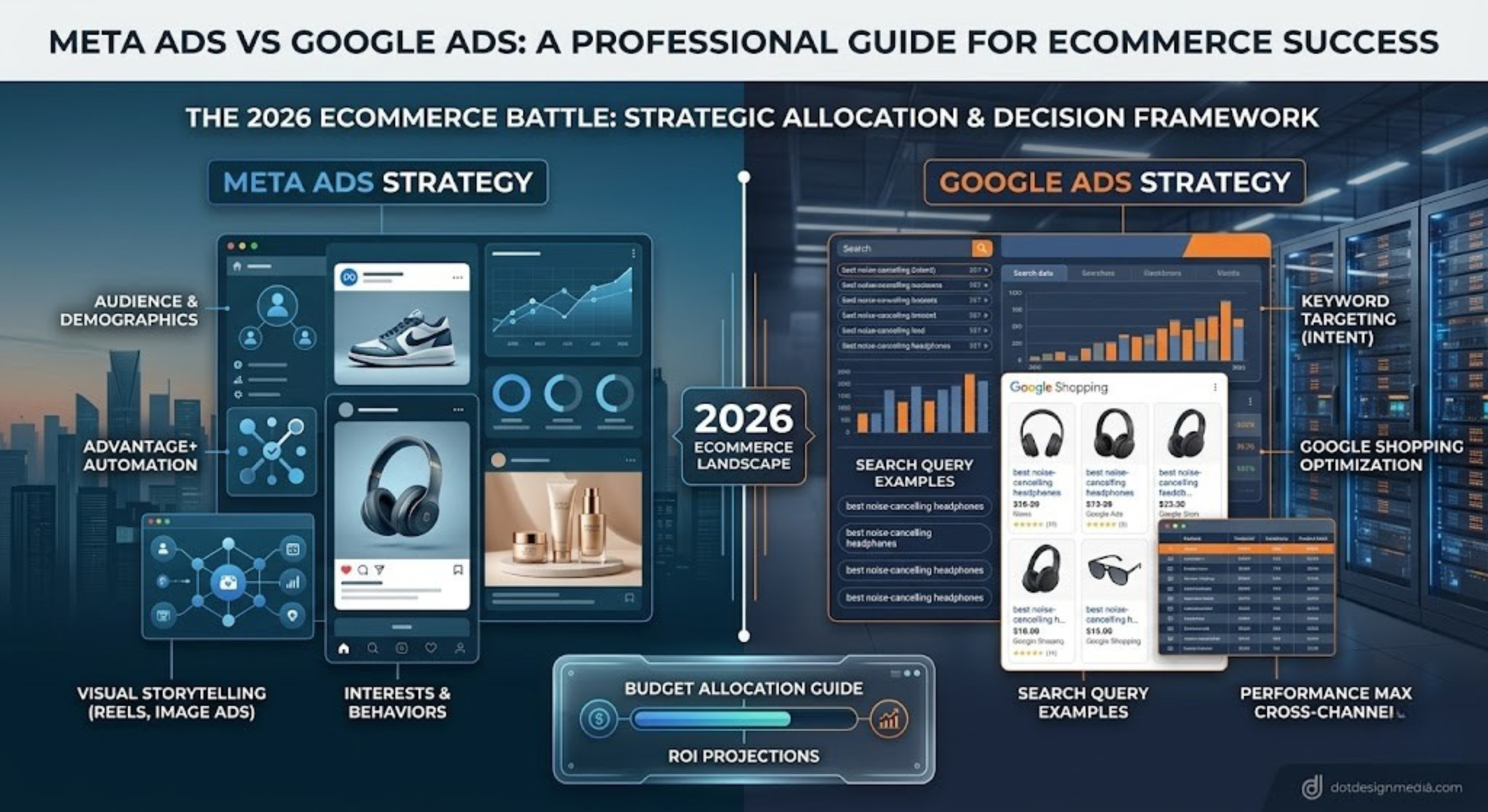
If you are running an ecommerce brand and trying to figure out where to put your advertising budget, you have probably asked this question at least once: should I use Meta Ads, Google Ads, or both?
The honest answer is that they do completely different jobs. Choosing between them without understanding the difference is one of the most common , and most expensive , mistakes ecommerce brands make.
At Dot Design Media, we manage campaigns on both platforms for ecommerce brands across Toronto, Oshawa, and Canada. Here is exactly how we think about it.
The core difference: demand capture vs demand generation
This is the most important concept to understand before you spend a single dollar on either platform.
Google Ads captures existing demand. Someone types "buy leather wallet Canada" into Google. They already want a leather wallet. Your ad appears at the top. They click. They buy. Google Ads works because it intercepts buyers who are already in purchase mode.
Meta Ads creates demand. Someone is scrolling Instagram and sees your leather wallet ad. They were not looking for a wallet , but now they want one. Meta Ads works by reaching the right person with the right product at the right moment, before they even knew they needed it.
Neither approach is better. They target different stages of the buyer journey , and the brands that use both are the ones that scale fastest.
When Google Ads works best for ecommerce
Google Ads is the stronger choice when:
- Your product has clear, searchable demand , people are already Googling for it
- You sell higher-ticket items where buyers research before purchasing
- You have a Shopify store with a well-structured product catalogue for Google Shopping
- You want to capture buyers who are ready to purchase today
- You are in a local service business where people search for providers near them
Google Shopping and Performance Max campaigns are particularly powerful for ecommerce. They show your product image, price, and brand directly in the search results , before the buyer even clicks through to your site.
The limitation of Google Ads is that it can only capture demand that already exists. If nobody is searching for your product category, Google Ads will not create that audience for you.
When Meta Ads works best for ecommerce
Meta Ads is the stronger choice when:
- Your product is visual , fashion, beauty, home decor, lifestyle, food
- You are launching a new product with no existing search demand
- Your product is an impulse or aspirational purchase
- You want to build a retargeting funnel to bring back visitors who did not convert
- You are trying to reach a specific demographic or interest group
Meta Ads , Facebook and Instagram combined , gives you access to 3 billion users and the most granular audience targeting available anywhere. You can reach people based on their interests, behaviours, demographics, and even their similarity to your existing customers through lookalike audiences.
The limitation of Meta Ads is that you are interrupting someone who was not looking for you. That means your creative needs to be strong enough to stop the scroll and your offer needs to be compelling enough to convert a cold buyer.
The cost difference: what to expect
Cost per click varies significantly between the two platforms and across industries, but here is a general picture for ecommerce brands in Canada:
Google Ads: Average CPC typically ranges from $1 to $4 for Shopping campaigns and $2 to $8 for Search campaigns, depending on competition. Cost per acquisition is higher, but intent is also higher , buyers from Google convert at a better rate.
Meta Ads: Average CPM (cost per 1,000 impressions) typically ranges from $8 to $20 for ecommerce audiences. Cost per purchase varies widely depending on your product, creative, and offer , but well-run campaigns typically deliver 3x to 6x ROAS.
The key insight: Google Ads often has a higher ROAS for products with strong search volume. Meta Ads often has a higher revenue ceiling because you are not limited by how many people are searching , you can scale to anyone who fits your audience profile.
How to use both platforms together
The most effective ecommerce advertising strategy uses both platforms in a coordinated way:
Meta Ads generates awareness and first-time purchases. Cold audience campaigns introduce your brand to new buyers. You test creative, identify what resonates, and build your customer base.
Google Ads captures buyers who search after seeing your Meta Ads. This is called the halo effect , someone sees your brand on Instagram, does not buy immediately, then Googles you later when they are ready to purchase. Google captures that intent.
Retargeting runs on both platforms simultaneously. People who visited your site but did not buy see your ads on both Instagram and Google. This multi-platform retargeting significantly increases conversion rates versus running retargeting on just one platform.
Which should you start with?
If you are a new ecommerce brand with a limited budget, start with Meta Ads. Here is why:
- You can start with $20 to $50 per day and get meaningful data
- The audience targeting lets you reach exactly who you want
- You can test multiple creative angles quickly to find what converts
- Retargeting campaigns on Meta are extremely efficient even at small budgets
Once your Meta Ads are profitable and you have a validated offer, add Google Ads to capture the search demand you are generating. At that point you will have the data, the creative learnings, and the customer proof to make Google Ads work.
Signs you are ready to run both
You are ready to run both platforms simultaneously when:
- You are spending at least $3,000 per month on Meta Ads and achieving consistent ROAS
- You have a validated product with proven demand
- You have conversion tracking set up correctly on both platforms
- You have the bandwidth to manage or outsource two separate campaign structures
The bottom line
Meta Ads and Google Ads are not competitors , they are complements. Google captures buyers who are ready to purchase now. Meta finds buyers who do not know they want your product yet. Used together with a clear full-funnel strategy, they are the most powerful paid advertising combination available to ecommerce brands.
If you are unsure which platform makes more sense for your specific product and budget, book a free strategy call with our team. We will review your current setup and give you a straight recommendation , no pitch, no fluff.
We are a performance marketing agency based in Oshawa, Ontario, specializing in ecommerce marketing for brands across Toronto, the GTA, and Canada.